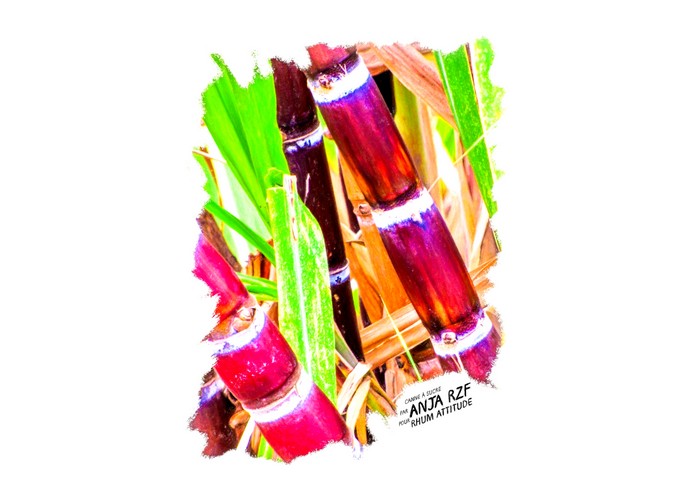
Rum has its vocabulary, its jargon, and it is not always easy to find your way around. Even seasoned enthusiasts wonder about notions that can be vague, and therefore sometimes diverted from their true meaning. However, it is important to be able to understand and decipher the labels, as well as the sometimes too well-coated speeches. This is why we offer you this little rum lexicon, a tool that we hope will serve as a machete in the tropical jungle of sugar cane spirits.
Agricultural
Agricultural rum is a rum made from pure sugar cane juice. A rum can benefit from this designation if it was produced in one of the overseas departments (Martinique, Guadeloupe, Guyana, Reunion) or on the island of Madeira . Elsewhere, these rums simply bear the name of "pure cane juice rums".
Iron still
This is the traditional still as used in cognac or whisky . Mostly made of copper, it is composed of a tank topped with a swan's neck where the vapors are concentrated. These then take a coil, where they cool and condense to return to the liquid state. We speak of repasse and discontinuous distillation because most of the time the liquid is passed through it twice in order to obtain a satisfactory alcohol, but it can also operate by single pass. Chamarel Cœur de Chauffe rum is an example of rum resulting from a double distillation.
Amber
An amber rum is a rum that has spent between 12 months and 3 years in a tuns or barrel. Below this period, it is always a white rum. Beyond 3 years, it is an old rum. We can find different names, amber, rum aged in wood, golden, gold or straw rum.
AOC
The Appellation d'Origine Contrôlée is a label that certifies that a rum has been produced in a certain region and according to certain specifications. Martinique is the only region in the world to benefit from this AOC, since 1996.
Assembly
This key step in rum making involves blending rums from different barrels, different ages, and different aromatic profiles to achieve a harmonious marriage. One of the main challenges of blending is to maintain a similar aromatic profile over time, batch after batch. We can cite Pusser's, a reproduction of the blend that was part of the rations of sailors in the British Navy.
Bagasse
It is the fibrous residue that remains after pressing sugar cane. Once dry, it is often used to fuel distillery boilers, or to feed animals.
White
A white rum is a colorless rum. But it doesn't stop there because there are some subtleties. It can be a rum that has simply not been aged. But it can also be a rum that has aged less than 18 months in a cask for example, or even an old rum filtered with charcoal, from which all its color has been removed, as for this Botran.
Blend
See assembly
Brut de fût
A rum that has not undergone any modification between its removal from the barrel and its bottling. It may sometimes have been reduced during aging. This term is a source of debate since in other spirits such as whisky, no modification is made during the entire aging period. This gives very powerful and expressive rums, like this famous Manutea from Moorea selected by Rhum Attitude.
Cachaça
A cousin of agricultural rum, cachaça is a Brazilian cane brandy. Made from pure cane juice, it is traditionally distilled in a still, in a single pass.
Cask Strength
A rum that has not undergone any modification between its cask and its bottling. It retains its alcohol content when it leaves the cask, without reduction.
Clairin
Eau-de-vie made from pure sugar cane juice (and sometimes syrup) made in Haiti . It is a very artisanal product most of the time: wild fermentation, distillation in a still, bottled without reduction. It is the Velier company that introduced these clairins to the world, working with the producers Sajous, Casimir and Vaval.
Column
The distillation column is a continuous distillation method, as opposed to the discontinuous distillation of the repasse still. The column is fed with steam from the base, and with must to be distilled from the top, without interruption. The liquid descends along the column and meets the steam, which carries with it the aromas and alcohol. The most famous are the traditional Creole columns (in copper) and Coffey (in steel). There are also coupled columns that produce lighter rums, and even multi-column installations from which very refined rums come out. For example, agricultural rums from Martinique are often distilled in Creole columns.
Distillation
It is a principle that aims to separate the different components of a liquid according to their boiling temperature. It is a way of separating alcohol and aromas from water, while concentrating them.
Dunder
See vinasses.
Raised in wood
See amber.
Independent bottler
Born from the world of whisky, this player in the world of rum plays an important role. It is a selector who does not produce its own rums, but selects them from distilleries or brokers, often offering alternative versions of officially bottled rums. Examples include La Compagnie des Indes , Kill Devil, Samaroli or Silver Seal.
Esters
They are part of non-alcohols, that is to say molecules other than water and alcohol. Even if they are not the only ones responsible, these aromatic components are at the origin of many aromas, and are measured to define the concentration of a rum. Jamaican rums are often defined as "high ester rums", they are for the most part very concentrated.
Fermentation
This key step occurs when the yeasts feed on the sugar present in the must (pure juice or molasses), thus releasing CO2 and alcohol. They will also create chemical reactions that will give rise to all sorts of aromas.
Filtration
It is often done cold (chill-filtration) and makes the rum clearer and more transparent. It carries with it the cask dust, but also fatty compounds, often a source of aromas. It can also be filtered on charcoal to remove the color from a rum. This is the case, for example, with Flor de Caña 4 years .
Finishing
This practice consists of finishing the aging of a rum in a barrel that previously contained another alcohol, to enrich the range of its aromas thanks to the liquid still contained in the wood. HSE has marked the world of agricultural rum with its famous world finishes.
Lightning
The foudre is a large vat, most often made of wood, where the rum is left to rest and aerate. Its large capacity means that the rum has relatively little contact with the wood. Most amber rums are aged in oak foudres, like this amber La Favorite.
Full proof
Refers to a rum that has not undergone any modification between its distillation and its bottling. Like cask strength, its definition is subject to interpretation.
Was
Synonymous with barrel or cask, this is where rums age. It can be of different capacities and different types of wood. It is most often made of oak (American or French), but you can also find acacia or chestnut, among others. Cachaças use local Brazilian species, as for this range offered by Soledade .
Great aroma
Highly concentrated traditional rum, for which vinasses were used during fermentation. It is often used as a flavor enhancer, to enhance the aromas of other rums or certain food preparations. Lontan de Savanna are grand aroma rums.
High Ester
Highly concentrated traditional rum, with or without the use of vinasse for fermentation. The term refers to a high level of aromatic compounds. Rums from the Hampden distillery are often high ester rums.
Industrial
Said of a molasses rum (from the industrial production of sugar). Synonym: sugar rum.
Rum liqueur
A rum that contains more than 100 grams of sugar per liter. Mauritian distilleries produce excellent rum liqueurs, such as Chamarel and its vanilla liqueur.
Cane honey
It is a pure juice of cooked sugar cane, reduced to the consistency of a syrup. Typically used at Barbancourt.
Molasses
It is the residue of sugar production, a black and viscous syrup that still contains sugar but is no longer crystallizable. It is diluted to prepare a molasses rum must.
Monovarietal
An agricultural rum that comes from a single species of sugar cane. Clément was the first distillery to offer white rums from the single blue cane.
Topping up
Consists of filling the evaporation of the rum in the barrel, by filling the void with a rum of the same age. This avoids too much oxidation, but above all more evaporation, because the emptier the barrel, the greater it is.
Overproof
This term refers to a rum that exceeds the "proof," according to the British Navy, which is the degree beyond which gunpowder ignites, even when soaked in rum. It was once a necessary criterion for carrying rum on military ships, although today more modern instruments are used to measure alcohol content. It was actually a volume ratio between the alcohol and water present in a spirit. The British defined 100 proof as 57.1% ("Imperial Proof"), and the Americans, who have retained the term, now set it at 50%. Jamaica is fond of these overproof rums, of which Wray & Nephew is a proud example.
Straw
See amber
Plot
An agricultural rum made from a single plot of cane. Longueteau 's single-plot rums have particularly distinguished themselves in this field.
Angels' Share
This is the evaporation of rum in the barrel. It is often three to four times more important in the tropics than in Europe. (2-3% against 8-10%)
Pot still
A retort still of the same type as that used for whisky. Caribbean pot stills are often equipped with retorts which allow for a single pass. The stills at the Hampden Distillery in Jamaica are good examples of Caribbean retort pot stills.
Reduction
This is the dilution of rum with water, in order to bring it to a desired alcohol level. It must be done gently and slowly to properly homogenize the mixture.
Single cask
A single barrel, isolated for its particular qualities. As opposed to an assembly of several barrels.
Small batch
Aging of a small batch. A limited production of old rum.
Solera
Aging process inherited from Spanish bodegas, particularly in the sherry sector. It consists of a pyramid of casks where the oldest rums are at the base (the solera), and the youngest on the upper floors (criaderas). When rum is drawn from the casks at the base, or when the angels' share has done its work, these casks are filled with the upper casks. It is then said that the oldest rums "educate" the younger ones. The age indicated for rums aged in Solera is therefore often that of the oldest rum, or sometimes an average. Santa Teresa 1796 rum is one of the most famous representatives of this method.
Spiced
Spiced rum, with fresh spices, infusions or syrups. These are often sweet rums. We can mention the classics such as Chairman's Reserve Spiced or Kraken.
Spirits
An alcoholic beverage obtained by fermentation and then distillation, as opposed to a beverage obtained by fermentation alone.
Toasting
This is the toasting or "charring" of the cask. The inside of the cask is heated to create roasted aromas, bring out certain wood aromas (vanilla, cooked fruit), and promote the exchange between the wood and the liquid. With "charring" (also called "burning" or "carbonization"), a filtration effect can also be created thanks to the charcoal produced on the surface of the wood. Different levels of toasting or charring can be applied depending on the desired result. Flor de Cana rums are good examples of highly developed charring.
Traditional
Refers to a rum (agricultural or industrial) which contains a minimum of non-alcoholic compounds of 225 grams per hectolitre of pure alcohol (225g/hlap).
Aging
It is the act of aging a rum in a barrel.
Vinasses
It is the residue of distillation, the liquid that is exhausted in alcohol after the operation. Rich in acids and potassium, they are often used as fertilizers. They can also be reused for fermentation, creating an acidic environment conducive to the work of yeasts and thus very aromatic rums. The Savanna distillery, in Reunion, produces a grand arôme rum for which vinasses are used for fermentation.
Vesou
It is the cane juice which is used to prepare a pure cane juice rum must or agricultural rum.
VO
Very Old: A rum that is at least 3 years old. It can also be called old rum or VS.
VSOP
Very Superior Old Pale: A VSOP rum is at least 4 years old.
XO
Extra Old: An XO rum is at least 6 years old. It can also be called extra-old or hors d'âge.
Good morning,
Great glossary that will allow many to easily understand the labels.
If I may add:
"OVERPROOF". The gunpowder aspect does not concern the American "proof", but rather the British "Navy".
For those who are curious:
The English Proof, or Imperial Proof, was relevant to the time when the United Kingdom was not part of Europe. Perhaps we'll see it again with Brexit? Who knows? The definition of Proof was established by the customs service and by royal decree. -A "proof" spirit was defined by the Customs and Excise Act concerning spirits of "proof strength". "A spirit is deemed to be of proof strength if the volume of ethyl alcohol it contains, when mixed with a quantity of distilled water to make up the volume of the spirit, weighs one-twelve-thirteenths of a volume of distilled water equal to the volume of the spirit. The volume being measured in each case at 51°F. Therefore, it is a spirit which, at 51°F, weighs exactly one-twelve-thirteenths of a volume of distilled water equal to the volume of the spirit. This was in fact a mixture of spirits and water in a volume ratio of 57.1% spirits and 42.9% water."
How was "Proof Strength" verified? Before January 1, 1980, a "proof strength" spirit (of proven proof) was the standard for measuring the alcohol content of spirits of the same type. Hundreds of years ago, testing the alcohol content of spirits involved mixing the spirit with gunpowder and setting it alight. The powder had to ignite to pass the test. If it didn't catch fire, it indicated that the quantity of spirit, let's say rum, was below the "proof strength." So, 57.1%...
Over time, of course, this measurement system was perfected. "Around 1740, distillers (and the Customs and Excise services) began using Clark's hydrometer, designed to measure the strength of alcohol. A more precise version, invented by Bartholomew Sikes, was universally adopted under the Hydrometer Act of 1818 and remained the standard instrument until 1980."
I recognize that you can't put all of this in your lexicon, but for the curious among you, the explanation is to show that the proof is indeed a volumetric ratio.
-SMALL BATCH: (comes from bourbon), only concerns productions put in barrels.
-TOASTAGE: this word doesn't actually exist. In French, we say bouusinage (as you pointed out), which is the translation of 'toasting'. It shouldn't be confused with the English word 'Charring', which translates to carbonization; 'brûlage' and 'flambage' are also used, depending on the cooperage, to define 'Charring'.
This term was also corrected between the 1st and 2nd editions of the rum guide.
To keep things simple, each technique, "toasting" and "charring," involves several distinct heating stages. However, there's no burning involved in the charring process, just heating at different temperatures.
Thanks again for this glossary.
Looking forward to reading you, and I hope one day at a trade fair.
Jean-Marie Le Caignec
–
Hello Jean-Marie. Thank you very much for these clarifications, and these fascinating historical details on the notion of “proof” which for my part I only knew in broad outline.
Even if the idea of this lexicon is to provide simple keys to understanding, your comments will allow us to adjust it as soon as we have a little time.
Thanks again and have a great 2019!
Once again, many thanks to Jean-Marie for these comments and these details which I enjoy. I have updated the glossary thanks to your contribution. I hope that we can meet soon around a nice cane brandy.
Nico
Thank you very much for this glossary, I know a little more now and it is very pleasant, to better understand all the terms noted on our bottles.
Hello, I am trying to contact the Brussels magazine to see if I can pick up a product in the store or is it only online.
How can I know if the product I am looking for is available in store?
Hello, you can contact the Brussels store at this number: +32 492 20 02 35, or write an email to contact@rhumattitude.com
THANKS !